I love all of you but…

…we are inundated with new subscribers to the blog.

Unfortunately, this is also how the hacker got into the blog system last month.

Therefore, if you have a really funky email address, send me an email to let me know that you are legit. Otherwise, I’m deleting subscribers who, for instance, have names like “gyiklsiyod” or have any type email address that mentions “viagra” or similar.

Sorry!

Comments

Video link to canine exercise example

Comments

Fit Tip for 3/3/10 – elevate food and water bowls

This is part of a series in keeping your furkids, especially the elder variety, feeling and looking their best. It is not intended to supercede medical advice or directives. You can check out more of the “TIPS” series under the category on the  right —->


Raising food and water bowls up off the ground is an especially good tip for geriatric dogs, arthritic dogs or dogs that need to put more weight on their hind limbs. (Remember this fact? HERE )

Elevating food and water bowls can also help motivate a dog toward more equal weight-bearing when standing if this is an activity in your rehab program.

Standing more upright with an elevated head lessens the stress on front limbs and the neck.

Comments

Consumer Spending on Pets in 2009

From Vet-Advantage weekly news: According to a report on AllAboutFeed.net, the American Pet Products Association’s annual survey found that overall spending in the pet industry – including food, supplies, veterinary care, live animal purchases and other services such as grooming, boarding and pet sitting – grew by 5.4 percent from $43.2 billion in 2008 to a little more than $45.5 billion in 2009. Some of the spending trends that APPA highlighted included: most of a consumer’s pet budget goes to health care; pet services is the next-fastest-growing category; and supplies and over-the-counter medications showed steady growth of about 4 percent for 2009.

Comments

news links

Here is a link to information about the possibility of your dog drinking infectious water -here

- bring your own portable bottles/bowls to doggie play times wherever they may be!

Obesity among dogs is epidemic. Here is a link regarding “low cal” pet foods-here

- increasing exercise time and decreasing the amount of table scraps is still the best way to approach this!

Comments

Is a Dog Capable of Breaking Its Tail?

tailwaggin1

I received this very question this week (and many times previously), hence today’s posting topic.

- “Is it possible that my dog broke her tail? Do dogs’ tails break?”
Yes.

- “Isn’t a tail comprised of cartilage?”
No.

- “If my dog carries his tail to the side does that mean he broke it?”
Not necessarily.

A dog’s tail is comprised of individual boney segments much like the vertebrae of the rest of the spine. If a dog does fracture his tail and it is not reset, it may regrow at a funky angle.

The signs and symptoms vary wildly:
- Some dogs show pain and others don’t,
- Some dogs will still be able to wag their tails once broken and it is not necessarily indicative of a tail break if he or she suddenly can’t (it can mean other things too),
- It can be as insidious as hitting against an entry door or something as conspicuous as having had it stepped on (it happens to, or because of, the best of us!),

When in doubt, get it checked out!

(source of pic is http://sketchedout.wordpress.com/2007/11/11/tail-wagging-the-dog/)

Comments

New study for the predictability of back pain and dysfunction…

ATT00014141414

In this month’s Pulse magazine, recent research suggests that x-raying dachshunds at approximately 2 years of age is a good method of predict the possibility of future disc herniations and intervertebral disc disease.

The OFA and Penn Hips are well known and widely used radiographic ways to evaluate dogs like retriever breeds for the future possibility of hip dysplasia. The use of x-rays with chondrodystrophic dogs could function in the same manner as the above “diseases” are primarily genetic.
The article goes on to state that the incidence of disc herniation in “doxies” is 18% which is significant. Therefore, x-rays can be a cost-effective, non-invasive tool for owners of chondrodystrophic dogs to gain specific health knowledge of their dogs!

Dog breeds such as corgis, cocker spaniels, and “doxies” are called chondrodystrophic because of the shape of their bones. The breeds are described as having disproportionate legs (dwarfism) in relation to the rest of their body mass which makes it appear as their spines are abnormally long.

The incidence of spinal issues with these dogs is high when compared to other breed-types especially. Left untreated, such dysfunctions can most certainly compromise their quality of life and function when problems like pain, incontinence and even paralysis occur.

Using x-rays as discussed in the article listed in Pulse (from JVMA 2008; 233:1090-1095), may not only help to determine which dogs would be suitable for breeding programs but which ones will need early preventive measures to maintain healthy spines.

Some rehab methods we employ for dogs at risk or diagnosed with disc degeneration include, but are not limited to: core strengthening, weight control & restricted jumping activities (i.e., on/off the bed)!

Comments

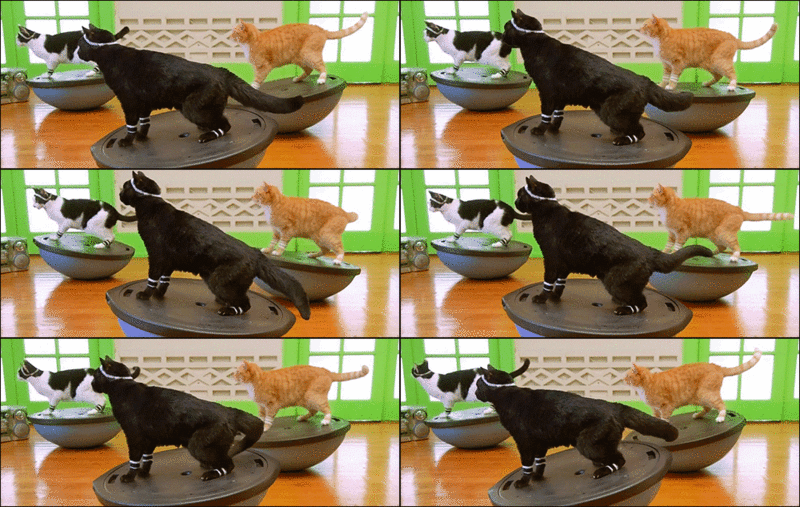
More examples of canine core strength…

The average dog’s bodyweight is distributed more heavily to his/her front legs- approximately 60%.

Given that fact, are you more appreciative of the skills of this dog in the video?
latinlbrador_1

Comments

It’s BACK…

…the PUPPY CAM, that is.

They started a revolution when they did a live stream of their first litter over a year ago.
Now, they’re back with a smaller litter born just a week ago. How fun it’ll be to watch when the pups get older and starting playing.
Better than watching a scrolling ticker tape of market updates and newsfeeds…

CLICK HERE

Comments

Animal Relief in Haiti

If you have been considering helping out additionally to the relief effort for the victims of Haiti’s recent earthquake, please take a look at what the good people of Best Friends Animal Sanctuary (recipients of my donation dollars!) are doing for the animals affected!

This is cruicial and critical.

PLEASE CLICK HERE

More information HERE
and HERE
and HERE

Comments

« Previous entries Next Page » Next Page »